
Related Tags
Featured Deal

Crazy Tube Circuits White Whale Junior review – real spring reverb and analogue tremolo in a compact pedal
Two of the oldest effects in stompbox history come together in a single pedalboard-friendly enclosure, and there’s no digital processing in sight…
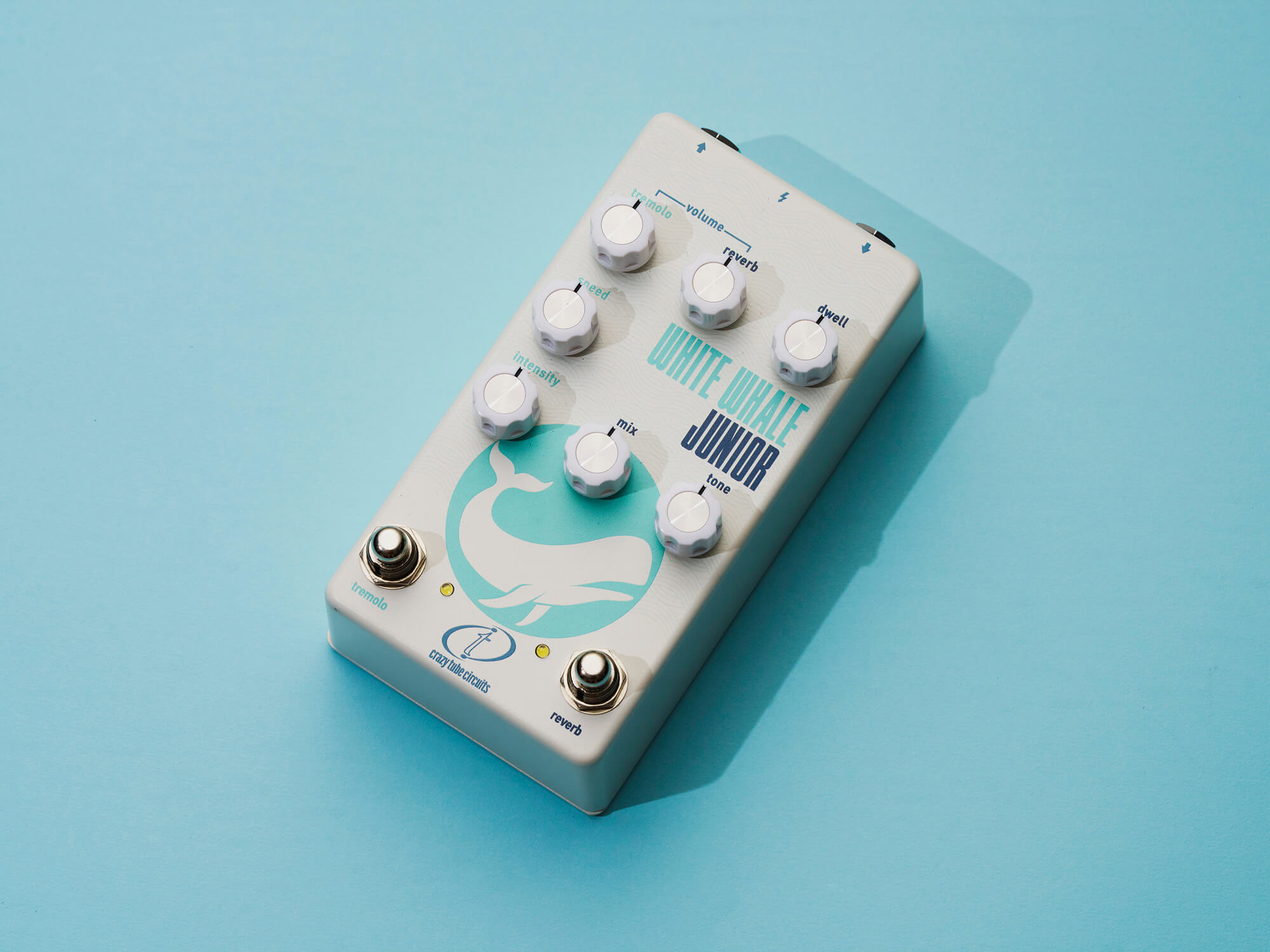
Crazy Tube Circuits White Whale Junior. Image: Adam Gasson
Review Overview
Our rating
8
Our verdict
⊕ …and the tremolo is more than just a bonus
⊕ Can also be set up for multiple stages of clean boost
⊖ Reverb is quite brassy even with the tone at minimum
⊖ It will resonate loudly if you accidentally kick it
Maybe ‘compact’ isn’t quite the word, but this is an impressive pedal that successfully distils the essence of the full-size White Whale into a significantly smaller unit.
€299/£259/$349, crazytubecircuits.com
I’ve just spent half the morning staring at the Crazy Tube Circuits White Whale Junior, trying to decide whether it’s a big small pedal or a small big pedal. This combined spring reverb and analogue tremolo unit doesn’t look large enough for something with ‘Whale’ in its name, and it doesn’t look little enough to be a ‘Junior’. What it does look is… slightly weird.
You see, this is a cut-down version of a very large pedal indeed – the White Whale V2 – and there’s only so much shrinking you can do when you’re getting your reverb from real springs. So what we end up with is something in the form factor of a compact stompbox, but one that’s been going hard on the protein supplements. That could still be a winning formula for a lot of players – as long as it sounds right.

What is it?
CTC describes the White Whale Junior as “possibly the world’s smallest fully analogue real spring reverb and amp-style tremolo” – and I’m not sure the ‘possibly’ is really necessary. For the record, it’s about 15cm (6in) long by 8cm (just over 3in) wide, and 5cm (2in) deep, not including the knobs and switches. You might be thinking that’s too small to hold a reverb tank, but the pedal is the tank, with the three-spring Accutronics assembly mounted to the baseplate.
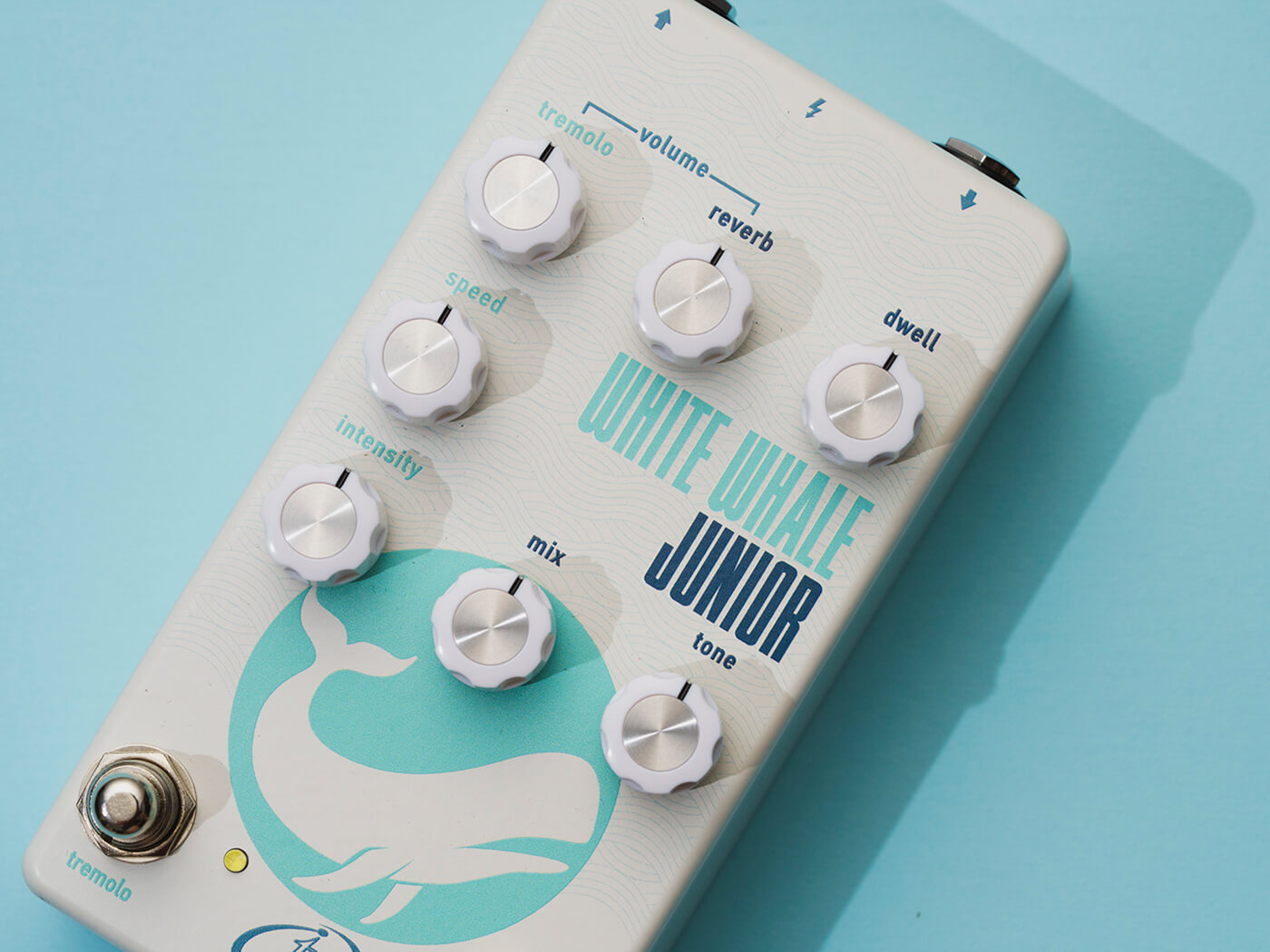
Tremolo and reverb each get their own soft-touch bypass footswitch, and these have been pushed right to the edges of the enclosure to leave a lummox-proof gap between them. The control knobs are actually the same as on the full-size pedal: speed, intensity and output volume for the tremolo; dwell, mix, tone and output volume for the reverb.
The only thing you don’t get is the White Whale V2’s trio of toggle switches – so the effect order is fixed at reverb first, the tremolo only has one mode instead of three (a sort of optical/bias hybrid), and the reverb length is fixed. Mind you, seeing as the dwell knob controls the gain going to the springs, pushing it will naturally make the vibrations audible for longer.

Build quality and usability
The White Whale Junior looks like a brick and it feels like one too – I’ve never had an issue with a CTC pedal, and this one is as solidly built as ever despite the unorthodox stuff going on inside. And the spring unit is a miniature work of art, even if some purists might bemoan the fact that Accutronics reverbs are made in Korea these days. The pedal itself is of course built in Greece.
The control array all looks pretty straightforward except for the indulgence of having separate volume knobs for the tremolo and the reverb. Wouldn’t a single one have done? Or even none at all? Well, yes. But as we’ll see a few paragraphs further on, that would be much less fun…
Sounds
One of the joys of real springs is that they can be set a-jangling by any kind of movement or impact, and that’s very much the case here – ker-splash, cha-clang, pi-zoinggg! You might consider this good news if you’re a fan of Joey Santiago’s amp-whacking noise effects (or the ‘kick pad’ on the old Danelectro Spring King), but it does have a downside: an accidental knock to the side of the enclosure will make it resound like a nuclear explosion in a tin bath, and even tapping one of the footswitches too hard can set it off.
So this pedal needs to be treated with a certain amount of care and respect… at least until you plug in a guitar and get playing. Then you can really start enjoying yourself.
I’ve hardly mentioned the tremolo up to now, so let’s start with that. It’s supposed to be amp-like and it absolutely is, with a smoothly organic shape that’s instantly engaging. The speed and intensity controls give you all the scope you could wish for, covering everything from a lazy throb to a rapid-fire judder, but the secret weapon here is the volume knob.
Plenty of tremolo pedals let you bump up the output to compensate for a perceived drop in level, but this one goes much further, packing a proper clean boost that could be almost as useful as the trem itself.
Even better, the reverb circuit’s volume knob does exactly the same thing – so even if you set one or both effect mixes to zero, you’ve got a mighty tasty boost pedal offering three footswitchable settings: a slight lift on one side, a bigger one on the other, and a bandmate-frightening option with both at once.
Don’t worry, I haven’t forgotten the reverb. It’s full of the joys of springs: bold and bouncy, with lashings of spanky character, and easily balanced with the dry signal for just as much surf-ready splashiness as you need. The absence of a switch for changing the decay length really doesn’t feel like a major issue.
The dwell control lets you crank up the intensity if you want to, but the only disappointment is that this reverb doesn’t have a mellow setting. Turning down the tone knob will take the edge off, but even at minimum it sounds brighter and lighter than the full-size spring reverbs in my amps. Maybe a lack of tonal depth is the price you have to pay for smallness – but that won’t bother you if you’ve only come for the surfing.

Should I buy one?
If you’re tempted by the grown-up White Whale but have been put off by its pedalboard-hogging dimensions, this is probably the solution you’ve been waiting for. That is, as long as you don’t need harmonic tremolo, which the Junior doesn’t have – arguably the biggest compromise CTC has had to make here.
The only other reason to avoid this pedal is if you like your reverb on the warm and subdued side – for that, you might have to go digital (or much bigger). But step this way for zingy springs and sweet tremolo in one relatively manageable box.
Alternatives
The aforementioned White Whale V2 (€349/£299/$385) is a whopper, but not a whole lot more expensive than the Junior model – and it has a harmonic tremolo mode. The zany Gamechanger Audio Light Pedal (€379/£329/$399) uses springs for reverb, tremolo and more; but if you just want real spring reverb on its own, you do have an even smaller option in the Danelectro Spring King Junior ($199/£179).

A gigging musician since age 16, and a regular Guitar Magazine contributor since 2009 (when it didn't even have a website yet), Richard also posts short pedal demos on YouTube. He is a UK-French dual national and hopes to be reincarnated as a Rickenbacker.